Fuji Pilot Project
About 70% of the territory of Japan is covered by forests, making wood a very familiar material for the Japanese. Being a country with frequent earthquakes, Japan has strict regulations concerning building constructions in relation to earthquakes and fires. In addition, as an island nation with a high population density, securing housing and construction sites means that plots are small and roads are narrow. Furthermore, most of Japan lies in the humid subtropical climate zone, but due to high humidity in summer and severe dryness in winter, it is essential to have measures for adjusting the humidity level to maintain a comfortable indoor environment, as well as durability measures for the exterior components, which suffer from severe deterioration. Based on these characteristics and legal constraints in Japan, we have tried to customize and adapt the CREE system for Japan. Moreover, to determine whether the system would be approved in Japan, we have set up a phase to construct a prototype building within the research center of Asahi Kasei Homes in Fuji City, Shizuoka Prefecture, and to evaluate and verify it.
There are two major evaluation and verification items: the first is the analysis of whether it would be possible to carry out the construction, and the second is the performance and value verification. Regarding the first point, the feasibility of the construction, we have checked whether there are factories that can produce the large components like the ones used in the CREE System, whether it is possible to transport them considering the road conditions in Japan, whether such large components can be constructed, and what kind of restrictions there are. For the second item, performance and value verification, we have considered the feasibility of the initial simulations by measuring insulation, airtightness, internal environment, and energy consumption. In addition, the sensory evaluation of the indoor space (comfort and coziness) is also ongoing, with continuous verification by means of surveys.
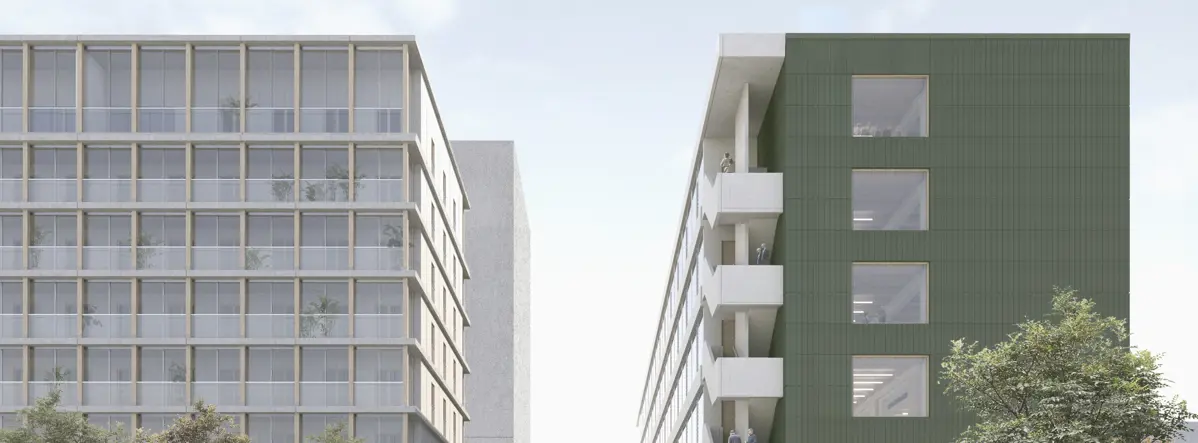
In terms of facade design, we avoided using wooden components outside, instead utilized metal and tile panels which are less prone to deterioration. The metal panel is lightweight enough to be installed by human power alone, combining design and construction with the ability to finish smoothly even with large panels, without wrapping. We have adopted a special fixation method that allows for lateral deformation during an earthquake, preventing damage and dislodgment during earthquakes. We have created a dynamic design by randomly placing vertical joints. We also ensured visibility of the wooden structure inside from the outside using glass curtain walls.
The awning above the entrance creates a light feeling with wooden louvers and glass. These louvers are the only exterior component made out of wood (LVL), and we continuously observie the changes in color it undergoes in this environment. For the exterior landscaping, we used natural materials such as stones and trees. By stacking stone jars without using mortor, we designed them for possible dismantling and reuse, conscious of a circular economy.
For the interior, we emphasized exposed timber structures to provide a sense of familiarity and relaxation with wood that is familiar to the Japanese people. However, basically, exposed timber structures can only be made up to quasi-fire resistant structures in Japan. Therefore, for FPP, we planned for a three-story building, assuming the use of offices to make it a quasi-fire resistant structure.
In accordance with Japan’s road conditions, we adjusted the maximum dimensions of the large components. The maximum dimensions of the TCC panels are 2m by 8m, and the exterior wall panels are divided according to the width of the TCC panels, and the columns and walls are separated to prevent damage during an earthquake.
The exterior wall, including breathable waterproof layers and airtight layers, was manufactured at a factory and filled with high-performance insulation material. The U-value of the wall panels is realized at 0.2. Wall panels are fixed in a curtain wall format. Fixing the wall panels at the top and bottom allows for the rotation of the wall panels during an earthquake which prevents damage.
The structure is a hybrid of timber and steel construction. In the CREE system, the vertical core is accustomed to be made out of reinforced concrete. However, Asahi Kasei Homes, which has been a steel house manufacturer for 50 years, selected a steel frame structure for the core part to leverage its expertise in steel frame systems. The steel part uses Asahi Kasei’s original HBS system, which can shorten the construction period by reducing the number of bolts compared to conventional steel structures, and reduce the number of trucks needed for transportation. The design allows the steel part to bear 100% of the lateral force without burdening the wooden columns or exterior wall panels. Multiple experiments at the research center have confirmed that even when deformation occurs in the event of a major earthquake, the wooden columns do not suffer significant damage, and the exterior walls do not fall off.
Fuji Pilot Project is an important step towards exploring and realizing environmental architecture in Japan, and we will continue to seek an optimal solution for the environmental building in Japan through actual projects.